Publications
Journal Publications and Book Chapters
-
A. Wolek and D. Maity, Optimal duty-cycle-based control design to regulate a linear system. Submitted.
-
A. Wolek, I. E. Weintraub, A. Von Moll, D. Casbeer, and S.G. Manyam, Risk-aware autonomy for managing weapon engagement zones. Submitted.
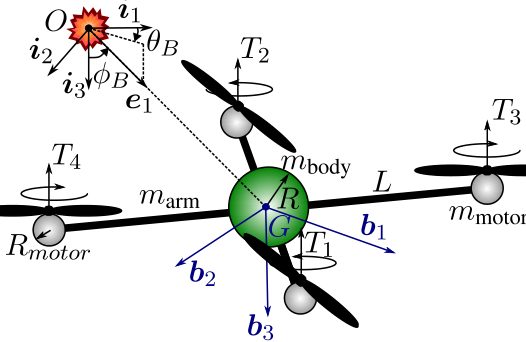
N. Kakavitsas, A. Willis, D. Maity, and A. Wolek, Fast estimation of the diffractive loads on a quadrotor UAV following an explosive blast. MDPI Aerospace, 13(7), 646.
Estimates the transient loads an explosive blast wave exerts on a quadrotor, modelling the airframe as four motor spheres and a central body joined by rods. Single-point overpressure models from the literature are extended to a wave sweeping over the moving vehicle, and checked against CFD.
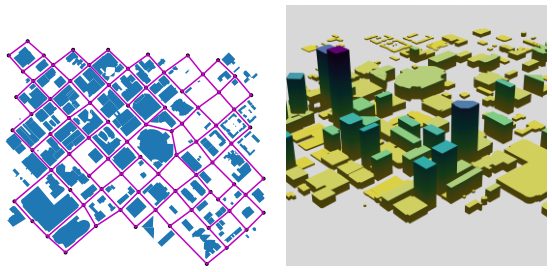
C. Hague and A. Wolek, Occlusion-aware ground target tracking by a Dubins vehicle using visibility volumes. AIAA J. Guidance, Control, and Dynamics. Accepted. In press, 2026. [preprint]
Keeps a Dubins UAV's line-of-sight sensor on a ground target moving through a city. A translating, radially time-varying circular standoff orbit is inscribed inside the visibility volume around the target, so the vehicle stays where buildings do not occlude the view.
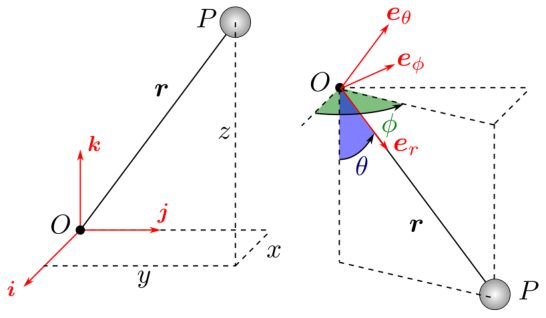
M. Nguyen, N. Kakavitsas, and A. Wolek, Spherical pendulum in wind: an inexpensive laboratory-scale experiment for exploring nonlinear dynamics and estimation. International Journal of Mechanical Engineering Education, 2026.
Derives the nonlinear dynamics of a spherical pendulum under quadratic aerodynamic drag in a steady horizontal wind, then realises it as a ping-pong ball on a string. The apparatus doubles as an inexpensive wind sensor and as a teaching experiment in nonlinear dynamics and estimation.
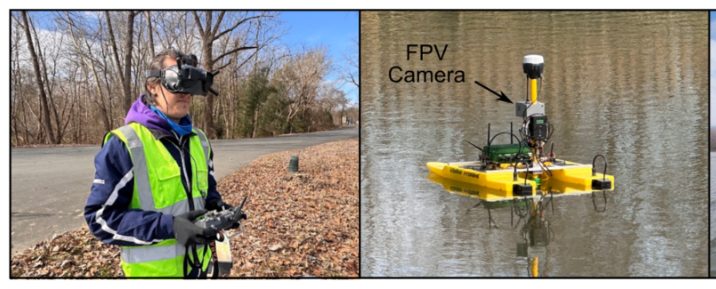
A. Nikonowicz and A. Wolek, Performance characterization of a small portable uncrewed surface vessel for bathymetry mapping near bridges using a single-beam echosounder , Drone Systems and Applications, 14:1-16, 2026.
Reports 41 hours of on-water testing of a small commercial uncrewed surface vessel at ten lakes and rivers, assessing its fitness for bridge-scour bathymetry work by a state transportation agency. Quantifies battery consumption, GNSS quality near occluding structures, and survey performance.
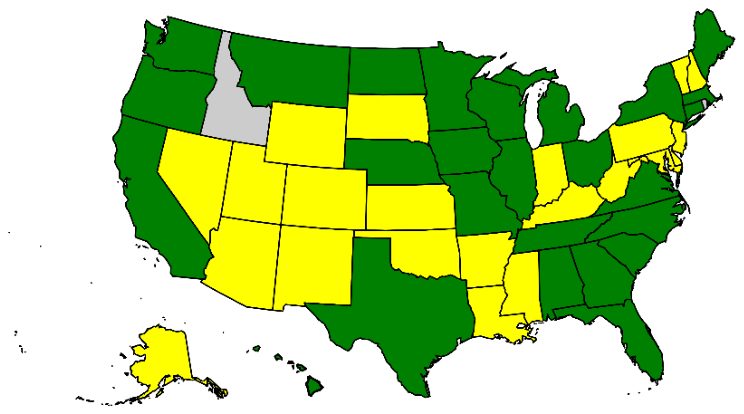
A. Nikonowicz and A. Wolek, A survey of uncrewed surface vessels for inland bathymetric data collection by U.S. state transportation agencies , Marine Technology Society J. Accepted. In press, 2026.
Reviews how U.S. state transportation agencies are adopting uncrewed surface vessels for inland bathymetry — scour monitoring, flood modelling, dredging assessment — and compiles a dataset of 91 commercial vessels with a grouping scheme for comparing them.
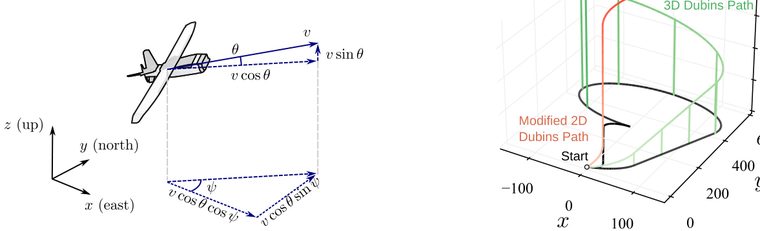
C. Hague, A. Willis, D. Maity, and A. Wolek, Minimum-time Dubins airplane tours to inspect targets with visibility and dwell time constraints. AIAA J. Aerospace Information Systems, 23(6):507-528, 2026.
Plans a minimum-time inspection tour for a 3D Dubins airplane that must hold each target in view, unoccluded, for a required dwell time. Treats 3D visibility, camera model (body-fixed or gimbaled) and dwell constraints together, where earlier methods handled them separately.
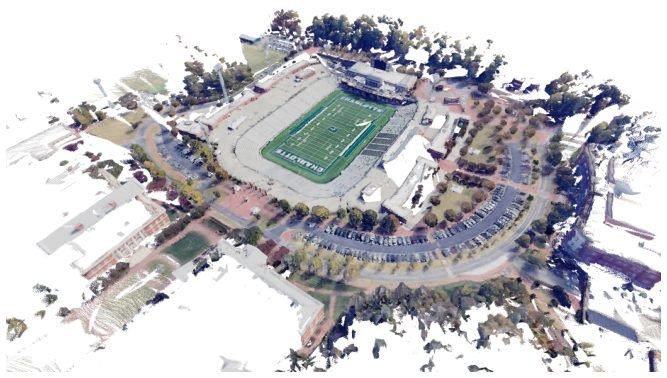
J. Zhang, A. Wolek, and A. Willis. UAV-borne mapping algorithms for low-altitude and high-speed drone applications. Sensors, 24(7):1-22, 2024. [preprint]
Benchmarks three visual odometry and mapping algorithms — DSO, Stereo DSO and DSO Lite — for low-altitude, high-speed drone flight. Experiments run in a high-realism environment built by fusing the AirSim simulator with Google 3D map models via Cesium Tiles, trading geometric accuracy against computational speed.
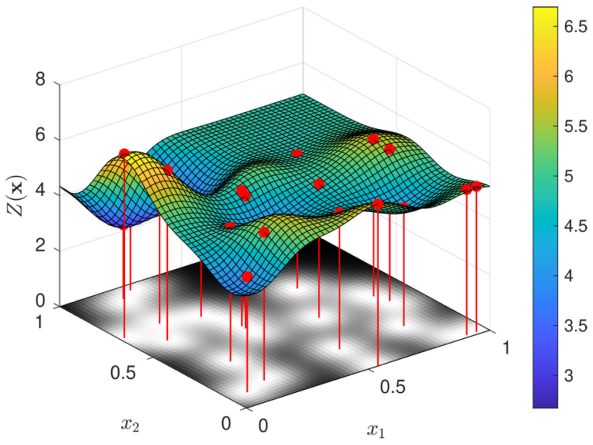
M. Brancato and A. Wolek. Adaptive sampling of a stationary Gaussian spatial process by a team of robots with heterogeneous dynamics and measurement noise variance. IEEE Access, 12:94407-94423, 2024. [preprint]
Lets a team of robots with different dynamics and different sensor noise jointly estimate and sample a Gaussian spatial field. Voronoi partitioning of a time-varying priority surface selects where to sample next, and each robot's path is shaped by a spring-and-damper waypoint model.
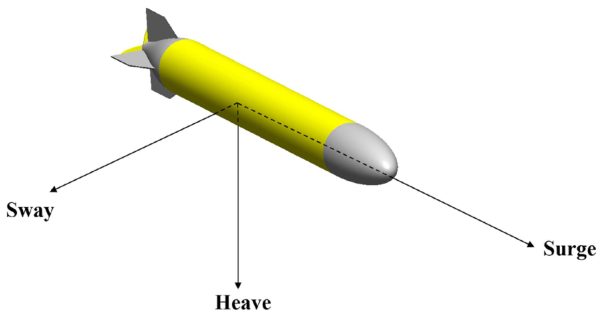
J. Jimenez, D. Stilwell, A. Wolek, J. McMahon, and B. R. Dzikowicz, Improved multitarget tracking in the presence of port-starboard measurement ambiguity using the Bayes factor. IEEE J. Oceanic Engineering, 48(1):199-217, 2023.
Addresses port–starboard ambiguity in passive sonar, where each bearing measurement maps to two possible sources. A Bayes factor test decides which side the sound came from, improving multitarget tracking of surface ships from an underwater vehicle.
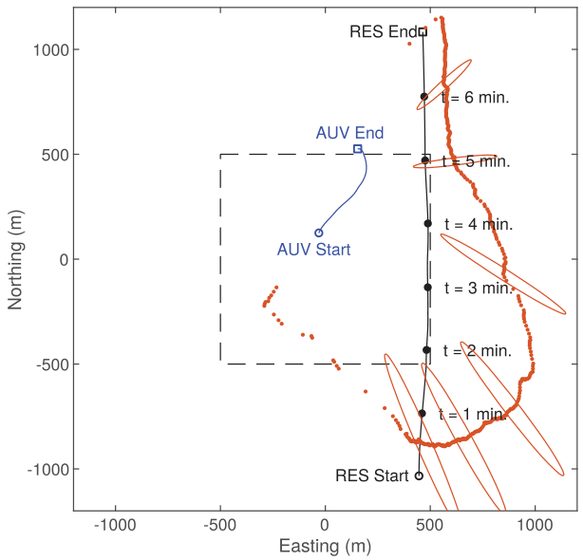
A. Wolek, J. McMahon, B. R. Dzikowicz, B. H. Houston, Tracking multiple surface vessels with an autonomous underwater vehicle: Field results. IEEE J. Oceanic Engineering, 47(1):32-45, 2022.
Repurposes an AUV's active-sonar hull array for passive listening, feeding a beamformer and a particle-filter tracker. An adaptive behavior then maneuvers the vehicle to keep several surface vessels inside the array's field of view. Results come from at-sea trials.
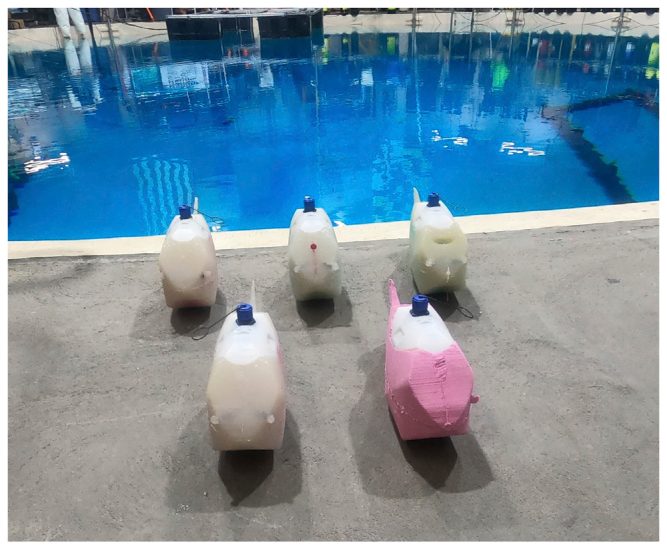
D. A. Paley, A. A. Thompson, A. Wolek, and P. Ghanem, Planar formation control of a school of robotic fish: Theory and experiments. Frontiers in Control Engineering, 2:782121, 2021.
Stabilizes parallel and circular formations in a school of robotic fish actuated by internal reaction wheels, whose closed-loop swimming dynamics reduce to the canonical Chaplygin sleigh. Covers both the nonlinear control design and tank experiments.
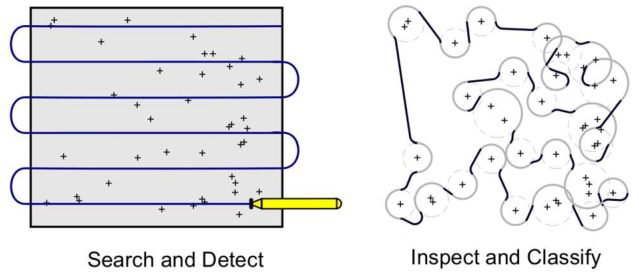
A. Wolek, J. McMahon, B. R. Dzikowicz, and B. H. Houston, The orbiting Dubins traveling salesman problem: Planning inspection tours for a minehunting AUV. Autonomous Robots, 45(1), 31-49, 2021.
Defines the orbiting Dubins traveling salesman problem: a minimum-time tour in which a curvature-constrained vehicle inspects each target by orbiting it along a circular arc. Motivated by minehunting, where sonar must observe an object from several relative geometries to classify it.
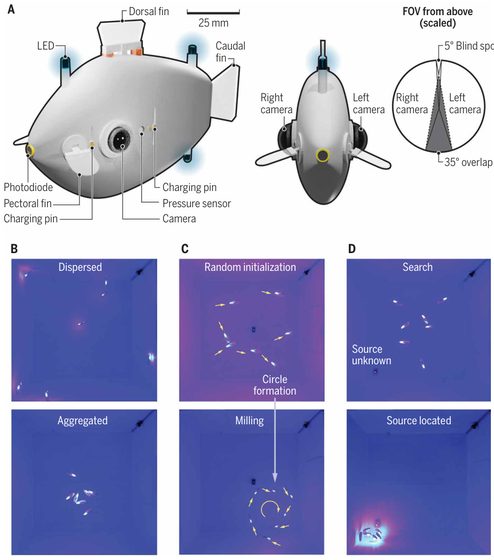
A. Wolek, D. A. Paley, A 3D underwater robotic collective called Blueswarm. Science Robotics, 6(50):eabf4315, 2021.
A Focus commentary discussing Blueswarm, a collective of agile fish-like underwater robots built by researchers at Harvard, which coordinate implicitly through vision alone to produce self-organizing three-dimensional behaviors in a laboratory tank.
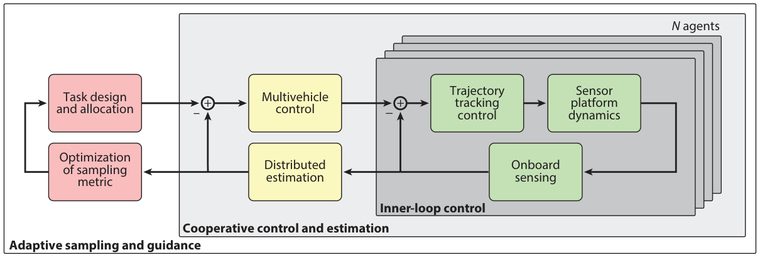
D. A. Paley, and A. Wolek, Mobile sensor networks and control: Adaptive sampling of spatiotemporal processes. Annual Reviews: Control, Robotics, and Autonomous Systems, 3:91-114, 2020.
A review of adaptive sampling, in which measurements from mobile sensors update a model of an unknown process, and that model in turn decides where to measure next. Covers platform models in ambient flow, assimilation into space- and time-varying process models, and information- and uncertainty-based metrics for scoring candidate trajectories.
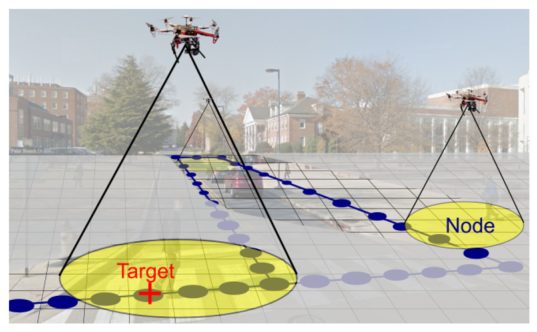
A. Wolek, S. Cheng, D. Goswami, D. A. Paley, Cooperative mapping and target search over an unknown occupancy graph using mutual information. IEEE Robotics and Automation Letters, 5(2):1071-1078, 2020.
A team of quadrotors with noisy, range-limited sensors must find a moving ground target in a city they have not yet mapped. Mutual information defines a sampling-priority surface, which a weighted Voronoi partition turns into waypoint tasks, assigned by solving a utility-maximizing assignment problem.
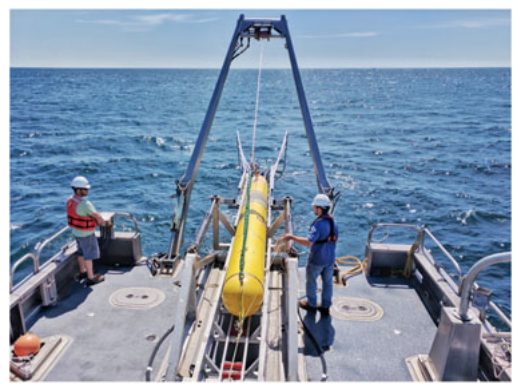
A. Wolek, B. R. Dzikowicz, J. McMahon, and B. H. Houston, At-sea evaluation of an underwater vehicle behavior for passive target tracking. IEEE J. Oceanic Engineering, 44(2):514-523, 2019.
Field trials in the approaches to Boston Harbor of a UUV behavior that detects a nearby vessel, executes a maneuver to resolve the port/starboard bearing ambiguity, then continuously steers to hold the target broadside to its hydrophone array.
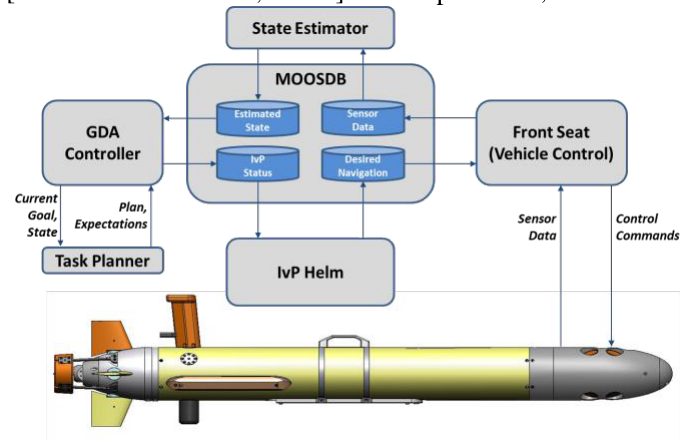
M. A. Wilson, J. McMahon, A. Wolek, D. Aha, and B. H. Houston, Goal reasoning for autonomous underwater vehicles: responding to unexpected agents. AI Comm. 31(2):151-166, 2018.
Applies a goal reasoning agent to an underwater vehicle operating in a partially observable, dynamic environment: an AUV pursuing a survey goal unexpectedly detects a potentially hostile surface vessel and must decide what to do. Simulations show goal-driven autonomy can reason about the situation within the limited computation available on an underwater platform.
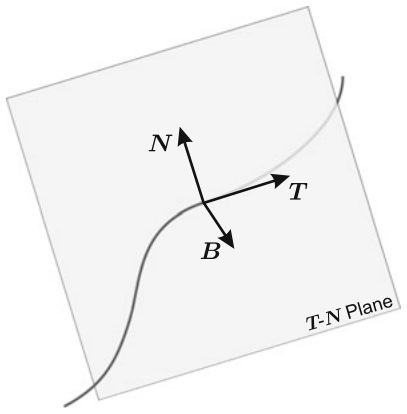
A. Wolek and C. A. Woolsey, Model-based path planning in Sensing and Control for Autonomous Vehicles, (Eds: T. Fossen, K. Pettersen, H. Nijmeijer), Springer Lect. Notes in Control and Information Sci., pp. 183-206, 2017.
A book chapter surveying the dynamic models commonly used for ground, surface, underwater and air vehicles, then comparing five families of path-planning method — optimal control, level set methods, coarse planning with smoothing, motion primitives, and random sampling.
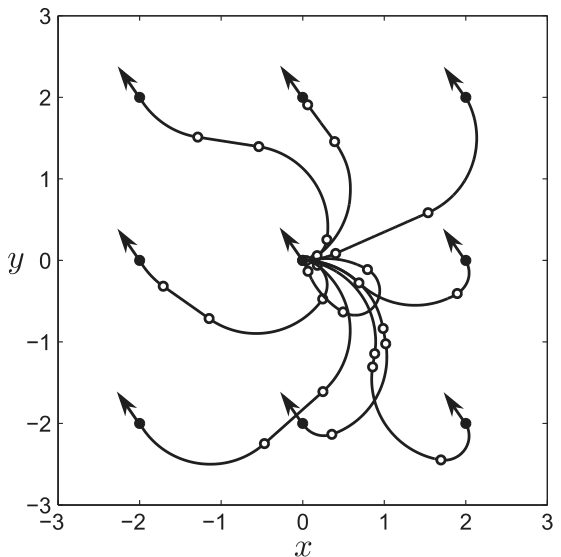
A. Wolek, E. M. Cliff, and C. A. Woolsey, Time-optimal path planning for a kinematic car with variable speed. AIAA J. Guidance, Control, and Dynamics, 39(10):2374-2390, 2016.
Solves minimum-time paths for a kinematic car controlling both speed and turn rate. The minimum principle plus geometric argument reduces the problem to a finite candidate set, and reveals that optimal paths can include 'cornering' turns taken at minimum speed and maximum turn rate.
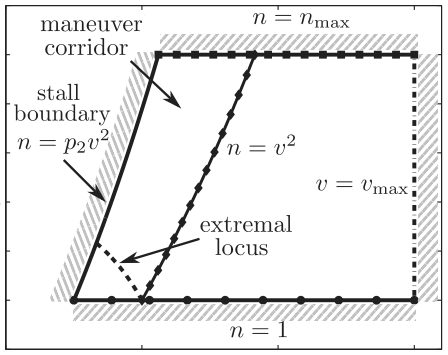
A. Wolek, E. M. Cliff, and C. A. Woolsey, Energy-optimal paths for a glider with speed and load factor controls. AIAA J. Guidance, Control, and Dynamics, 39(2):397-405, 2016.
Finds the path losing the least altitude for a glider reaching a specified position and heading, with speed and load factor as controls — extending Dubins-style planning to a vehicle whose sink rate depends on how it is flown.
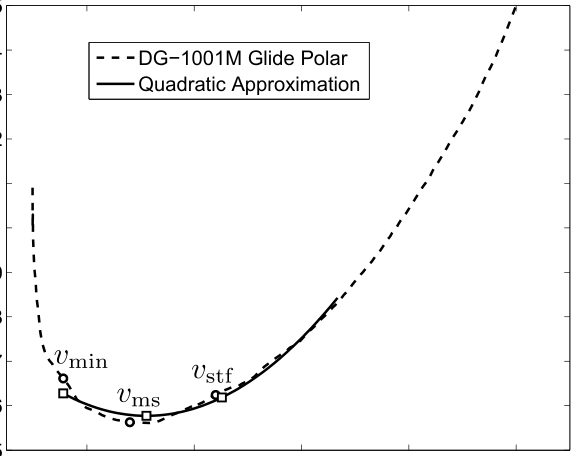
A. Wolek, and C. A. Woolsey, Optimal paths in still air for a sailplane with a quadratic glide polar. Technical Soaring, 40(2):9-23, 2016.
Minimizes altitude loss for a sailplane maneuvering in still air to a nearby position and heading, modelling it from above as a kinematic car with bounded speed and turn rate, and a sink rate set by a quadratic glide polar.
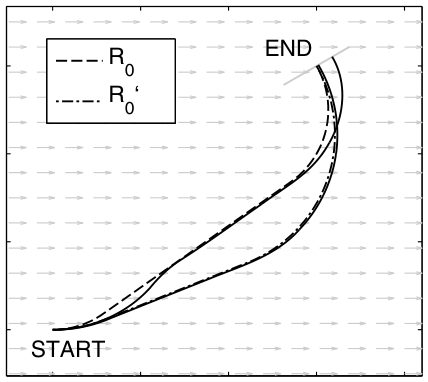
A. Wolek, and C. A. Woolsey, Feasible Dubins paths in the presence of unknown, unsteady velocity disturbances. AIAA J. Guidance, Control, and Dynamics, 38(4):782-787, 2015.
Asks when a Dubins path remains flyable once an unknown, unsteady current or wind is present. Dubins paths are optimal and easy to construct, but a vehicle pushed off course may need turn rates it does not have; this note gives conditions for feasibility.
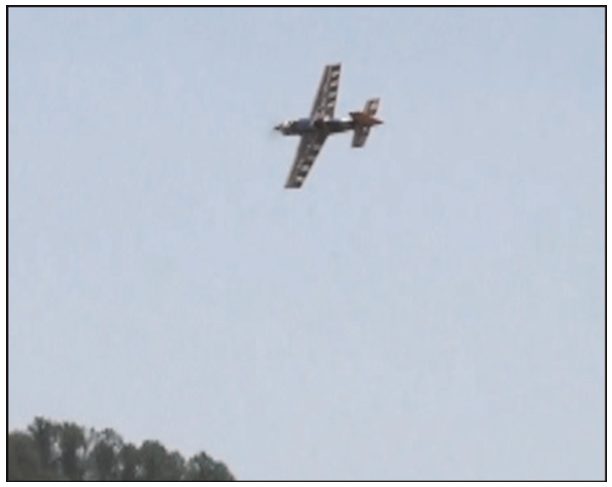
O. Bilgen, L. Butt, S. Day, C. Sossi, J. Weaver, A. Wolek, W. Mason, and D. Inman, A novel unmanned aircraft with solid-state control surfaces. J. Intelligent Material Systems and Structures, 24(2):147-167, 2012.
A servo-less remotely piloted aircraft whose control surfaces are Macro-Fiber Composite piezoelectric actuators that change camber directly. Includes vortex-lattice aerodynamic analysis, wind tunnel testing and flight demonstration.
Conference Proceedings
-
D. Sims, A. Wolek, Optimal spacecraft trajectory design with coupled thruster and reaction-wheel allocation: A comparison of approaches. Accepted to SciTech 2027.
-
A. Wolek, D. Maity, A. Von Moll, S. Manyam, T. Chapman, D. Casbeer, I. Weintraub,Sequential path planning through uncertain risk regions. Accepted to SciTech 2027.
-
D. Maity, A. Wolek, A. Von Moll, S. Manyam, T. Chapman, D. Casbeer, I. Weintraub,Minimum-time paths exploiting escorts in the presence of mobile pursuers. Accepted to SciTech 2027.
-
F. Rankin, A. Wolek, A. Willis, and D. Maity, Neural switching control with Lyapunov stability guarantees for robust multi-controller UAV operation. Submitted.
Combines reinforcement-learning control policies with Lyapunov stability constraints for UAVs carrying several controllers, extending neuro-Lyapunov methods beyond the usual single-controller, single-Lyapunov-function case.
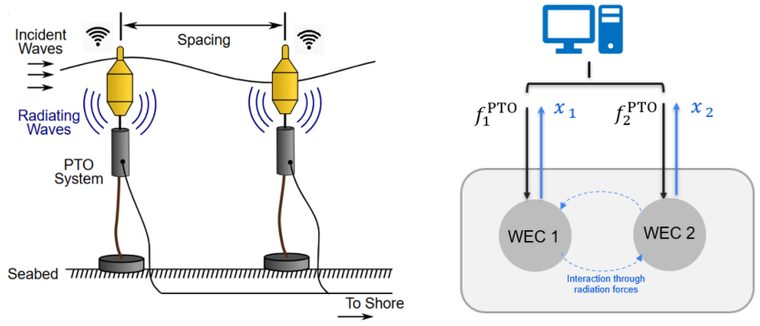
Z. Hashemi, D. Maity, and A. Wolek, POWER-Net: Predictive optimization and wave energy regulation in networked WEC systems. In Proc. 2025 University Marine Energy Research Community (UMERC) Annual Conference, Corvallis, OR, 2025.
Coordinates arrays of wave energy converters whose motions couple hydrodynamically through radiated waves. A centralized controller maximizes extracted energy from collective state information, with event-triggered communication to reduce how often devices must transmit.
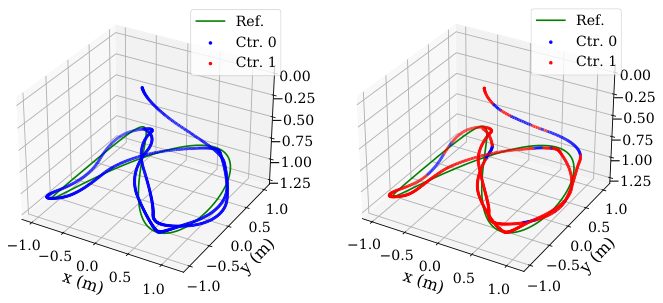
I. Albool, A. Willis, A. Wolek, and D. Maity, A reinforcement learning framework to adaptively schedule controllers for UAVs operating under harsh environmental conditions. In Proc. 2025 International Conference on Unmanned Aerial Systems (ICUAS), Charlotte, NC, 2025.
A hierarchical supervisory reinforcement-learning framework that schedules among several pre-tuned UAV controllers as conditions change abruptly, with sufficient conditions derived for switching stability.
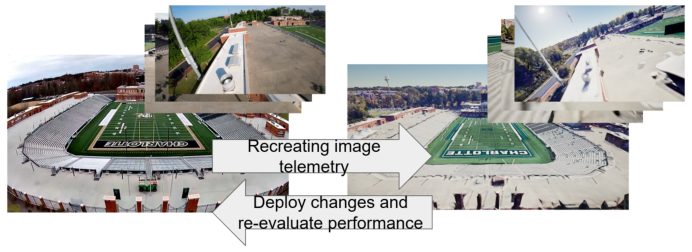
C. Beam, A. Wolek, and A. Willis, Recreation of 3D UAS flights in high-realism virtual environments , In Proc. 2025 International Conference on Unmanned Aerial Systems (ICUAS), Charlotte, NC, 2025.
Recreates a real UAV flight inside a digital twin built from Unreal Engine, AirSim and the Cesium/Google Maps plugin, then measures how closely image telemetry and generated maps from the simulated flight match the real one.
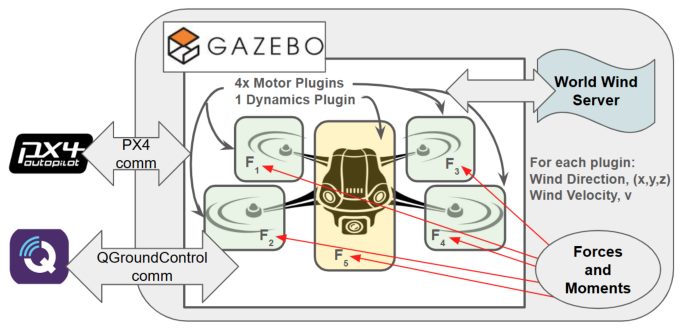
S. Parab, A. Wolek, D. Maity, and A. Willis, Real-time simulation of complex 4D wind fields and gusts for UAS control system development , In Proc. 2025 International Conference on Unmanned Aerial Systems (ICUAS), Charlotte, NC, 2025.
Gazebo plugins that inject time-varying 3D wind fields and short-duration gusts into ROS and PX4 software-in-the-loop simulation. A Fourier-based compression of large CFD datasets makes the fields cheap enough to evaluate in real time.
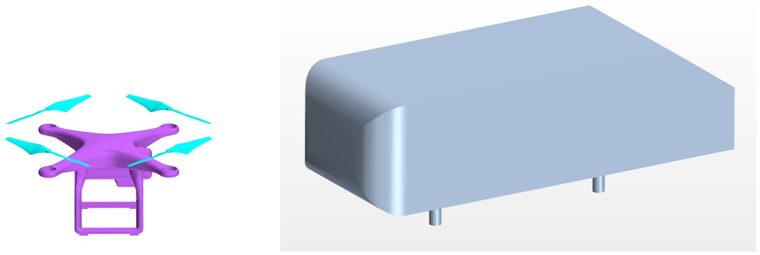
C. Hahn, A. Wolek, and M. Uddin, Characterizing vortex ring state during UAV landing on a ground vehicle using CFD , In Proc. AIAA SciTech 2025 Forum, Orlando, FL, 2025.
Uses CFD to characterize when a UAV descending onto a moving ground vehicle enters vortex ring state — the condition in which the rotor settles into its own downwash and loses lift — during autonomous landing maneuvers.
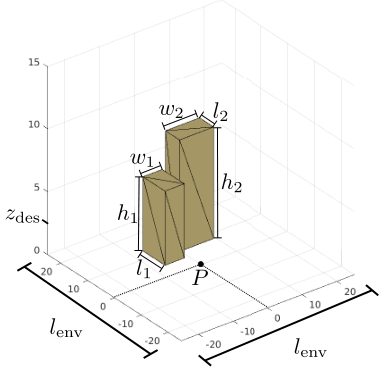
N. Kakavitsas and A. Wolek, Mapping urban wind fields via Gaussian processes regression models that consider building morphology , In Proc. AIAA SciTech 2025 Forum, Orlando, FL, 2025. [preprint]
Trains a Gaussian process on CFD data to reconstruct a steady urban wind field from sparse measurements. Instead of using measurement position alone, the covariance function incorporates building morphology, which is what actually shapes the flow.
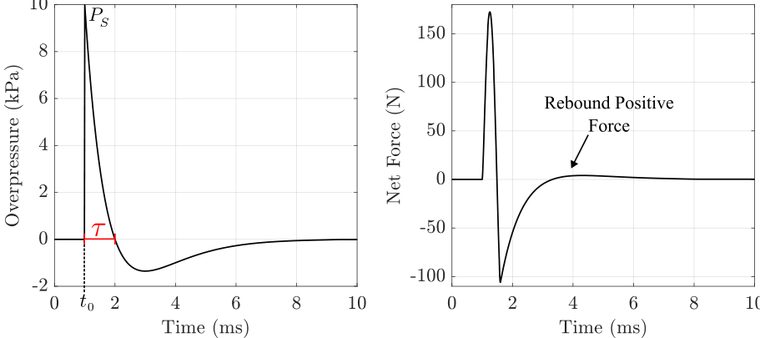
N. Kakavitsas, A. Willis, D. Maity, and A. Wolek, A quadrotor model for evaluating dynamic response to a blast pressure wave , In Proc. AIAA SciTech 2025 Forum, Orlando, FL, 2025. [preprint]
Models a quadrotor as four spherical motor elements and a central body connected by rods, driven by blast overpressure and induced-velocity models adapted from the literature and compared against CFD, to predict the vehicle's dynamic response.
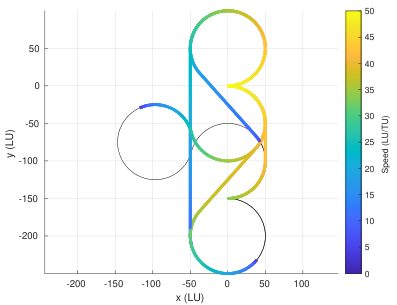
A. Wolek, D. Casbeer, I. Weintraub, and A. Von Moll, Maximum kinetic energy paths for a decaying-speed Dubins vehicle , In Proc. AIAA SciTech 2025 Forum, Orlando, FL, 2025. [preprint]
Steers a Dubins vehicle whose speed decays linearly with turn rate to a terminal point and heading while retaining maximum kinetic energy. Pontryagin's minimum principle yields extremals composed of straight segments and spiral-shaped turns.
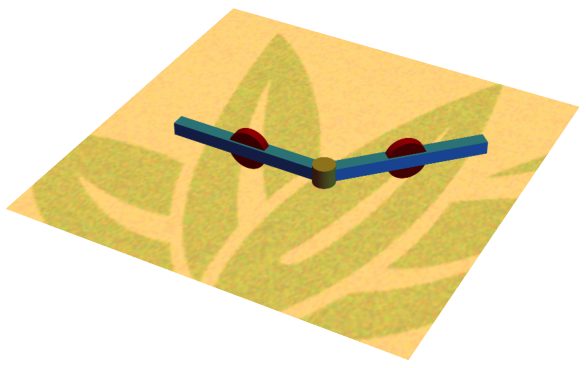
H. Moradi, A. Wolek, and S. D. Kelly, Mechanics and control of a freely rolling two-link robot with joint actuation , In Proc. IFAC 2024 Modeling, Estimation and Control Conference, Chicago, IL, 2024.
Reduces the dynamics of a two-link wheeled robot — hinged, free to roll and pivot but not slip, driven only by an internal joint torque — to a scalar nonholonomic momentum coupled to the joint angle, then uses that structure to steer it between target points.
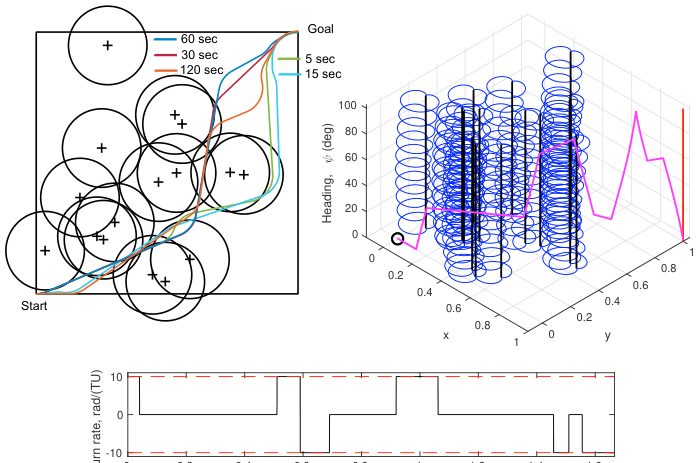
A. Wolek, I. E. Weintraub, A. Von Moll, D. Casbeer, and S.G. Manyam, Sampling-based risk-aware path planning around dynamic engagement zones , In Proc. IFAC 2024 Modeling, Estimation and Control Conference, Chicago, IL, 2024. [preprint]
Plans a feasible route for a Dubins vehicle through a field of dynamic engagement zones. Because each zone couples to the vehicle through its heading, the moving two-dimensional obstacles become static three-dimensional ones in a lifted (x, y, heading) space — which an RRT* can then search, where calculus-of-variations methods scale poorly and converge to local minima.
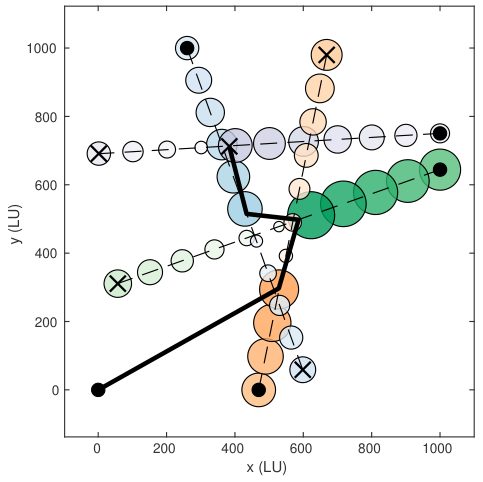
A. Wolek, Path planning for a cooperative navigation aid vehicle to assist multiple agents sequentially. In Proc. 15th IFAC Conference on Control Applications in Marine Systems, Robotics, and Vehicles, Blacksburg, VA, 2024. [preprint]
Plans a path for a single underwater cooperative navigation aid to intercept a set of agents in turn, minimising their average navigation uncertainty. Aiding is modelled by a scalar Kalman filter, and the planner also weighs surfacing to reset the aid's own uncertainty. A greedy scheduling heuristic is compared against exhaustive enumeration in Monte Carlo trials.
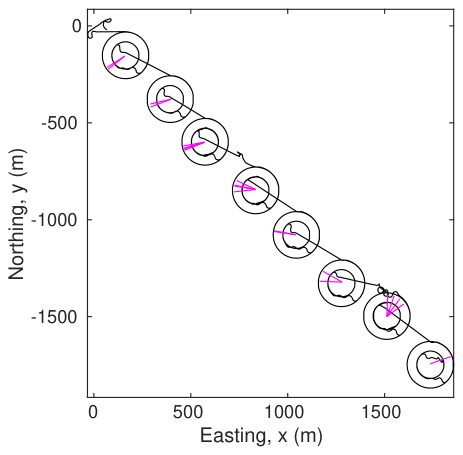
A. Wolek and J. McMahon, Batch estimation of a steady, uniform, flow-field from ground velocity and heading measurements. In Proc. 15th IFAC Conference on Control Applications in Marine Systems, Robotics, and Vehicles, Blacksburg, VA, 2024. [preprint]
Three batch estimators that recover the speed and direction of a steady, uniform flow field from noisy ground-velocity and heading measurements taken while a vehicle flies a circular orbit. Monte Carlo trials show how accuracy varies with measurement noise and with how much heading the maneuver sweeps.
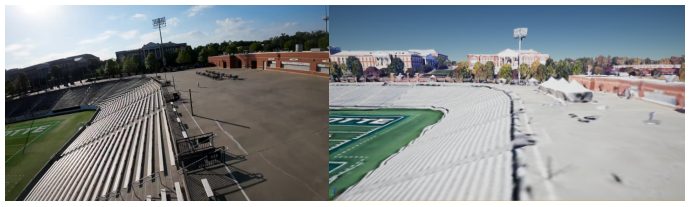
C. Beam, J. Zhang, N. Kakavitsas, C. Hague, A. Wolek, and A. Willis, Cesium Tiles for high-realism simulation and comparing SLAM results in corresponding virtual and real-world environments. In Proc. 2024 IEEE Southeast Con, Atlanta, GA, 2024. [preprint]
Builds simulated digital twins of real locations from AirSim, Unreal Engine and the Cesium plugin, and compares SLAM results obtained in the virtual environment against the same experiment run in the real world.
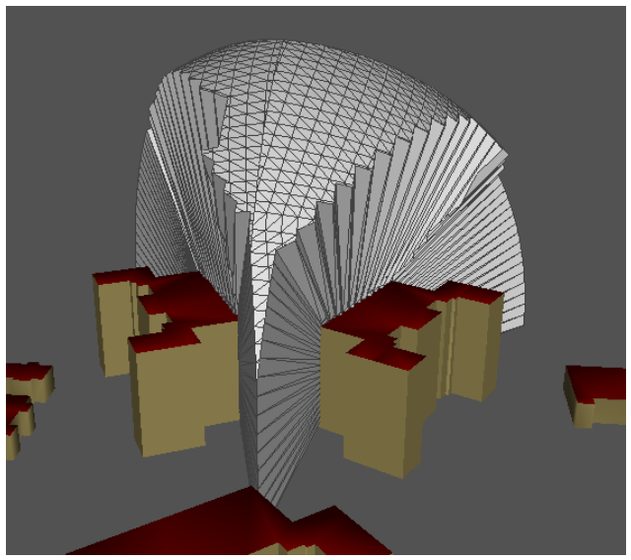
A. Willis, C. Hague, A. Wolek, and K. Brink, GPU-Accelerated 3D polygon visibility volumes for synergistic perception and navigation. In Proc. 2024 IEEE Southeast Con, Atlanta, GA, 2024. [preprint]
Computes 3D polygon visibility volumes on the GPU — the set of positions from which a UAV can see a given ground region without occlusion — generalizing the ground location from a point to a convex polygonal region, fast enough to use inside perception and navigation.
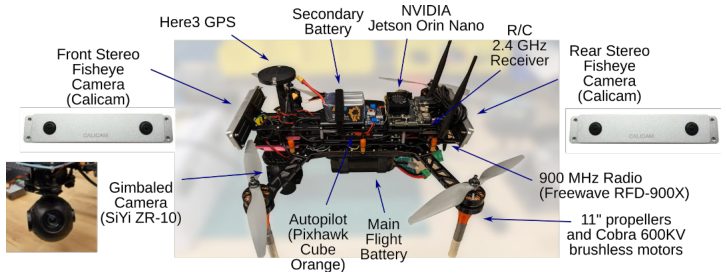
C. Hague, N. Kakavitsas, J. Zhang, C. Beam, A. Willis, and A. Wolek, Design and flight demonstration of a quadrotor for urban mapping and target tracking applications. In Proc. 2024 IEEE Southeast Con, Atlanta, GA, 2024. [preprint]
A quadrotor built for urban mapping and target tracking, carrying five cameras: two fisheye stereo pairs giving nearly omnidirectional coverage, plus a two-axis gimbal. Onboard Jetson Orin Nano and ROS handle data collection, with an autonomous behavior that tracks a moving GPS coordinate.
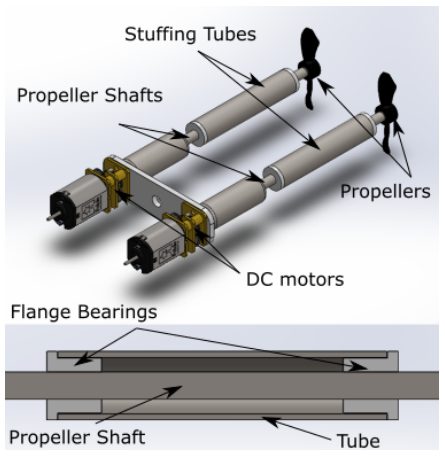
J. Herbert and A. Wolek, Design of a miniature underwater vehicle and data collection system for indoor experimentation. In Proc. 2024 IEEE Southeast Con, Atlanta, GA, 2024. [preprint]
A 3D-printed miniature underwater vehicle using differential propeller drive and a peristaltic pump with a syringe for buoyancy control, together with an instrumented water tank and overhead camera system for repeatable indoor experiments.
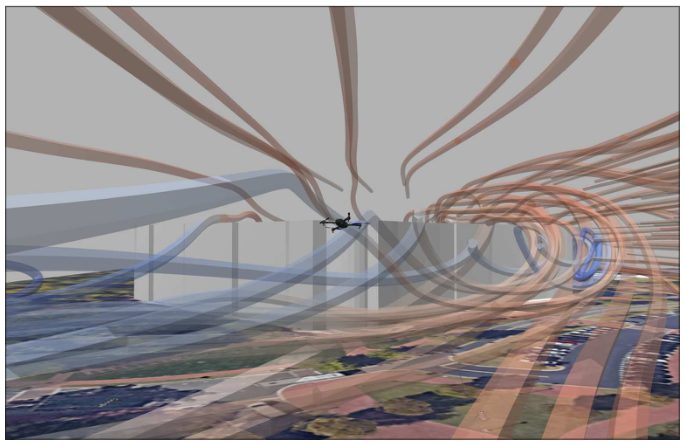
N. Kakavitsas, A. Willis, R. Jacobik, M. Uddin, and A. Wolek, Quadrotor flight simulation in a CFD-generated urban wind field. In Proc. 2024 IEEE Aerospace Conference, Big Sky, MT, 2024. [preprint]
A pipeline joining OpenStreetMap building geometry, an OpenFOAM steady CFD wind solution, Gazebo and PX4 software-in-the-loop. A 3D wind plugin interpolates the precomputed field at runtime, so a quadrotor can be flown in a realistic urban wind.
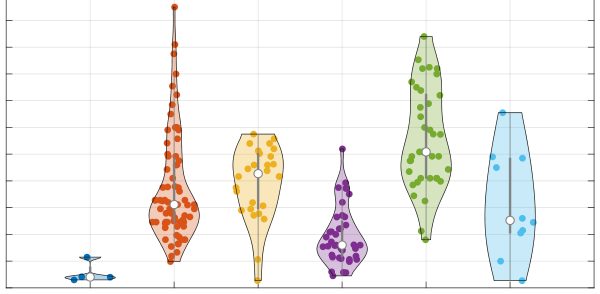
N. Kakavitsas, A. Willis, J. Conrad, and A. Wolek, Comparison of size and performance of small vertical and short takeoff and landing UAS. In Proc. 2024 IEEE Aerospace Conference, Big Sky, MT, 2024. [preprint]
A dataset of nearly two hundred vertical and short takeoff and landing uncrewed aircraft under 500 lb — gross weight, endurance, span, speed, payload and payload fraction — visualized and compared across design types and UAS group numbers.
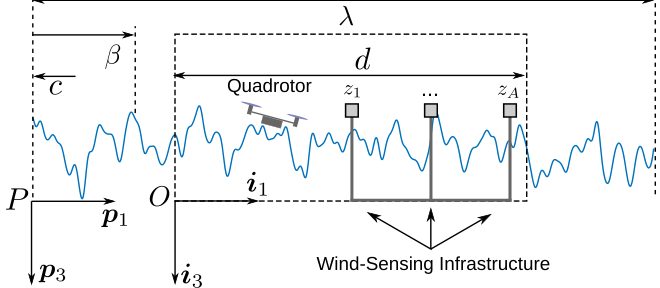
N. Kakavitsas and A. Wolek, Quadrotor takeoff trajectory planning in a one-dimensional uncertain wind-field aided by wind-sensing infrastructure. In Proc. AIAA SciTech 2024 Forum, Orlando, FL, 2024. [preprint]
Plans an optimal takeoff for a quadrotor climbing through a one-dimensional wind field that drifts across the operating area at a known speed, using noisy anemometer measurements from ground-based wind-sensing infrastructure to reduce uncertainty ahead of the vehicle.
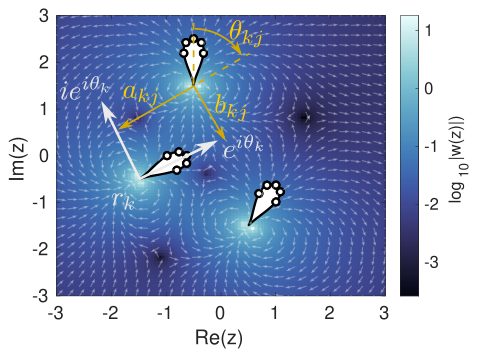
A. Wolek and D. A. Paley, Output feedback formation control of a school of robotic fish with artificial lateral line sensing. In Proc. IEEE/RSJ Int. Conf. Intelligent Robots Sys., Detroit, MI, 2023. [preprint]
Stabilizes parallel motion in a school of robotic fish using only an artificial lateral line — pressure measurements taken along each body. A particle filter infers neighbours' relative position and heading from a dipole potential flow model.
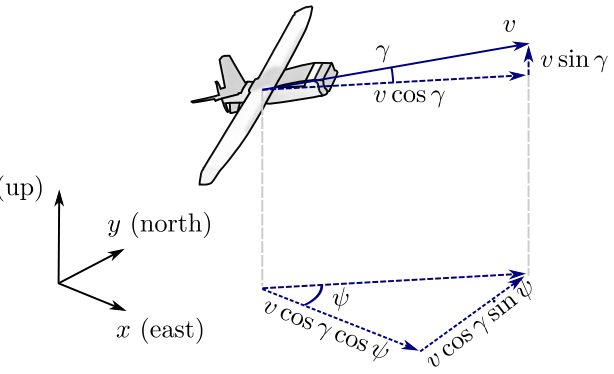
C. Hague, A. Willis, D. Maity, and A. Wolek, Planning visual inspection tours for a 3D Dubins airplane model in an urban environment. In Proc. AIAA SciTech 2023 Forum, National Harbor, MD, 2023. [preprint]
Plans a minimum-length tour for a 3D Dubins airplane inspecting targets on the ground or on the exterior of buildings, modelled as 2.5D extruded polygons, with visibility volumes defining where each target can be viewed without occlusion.
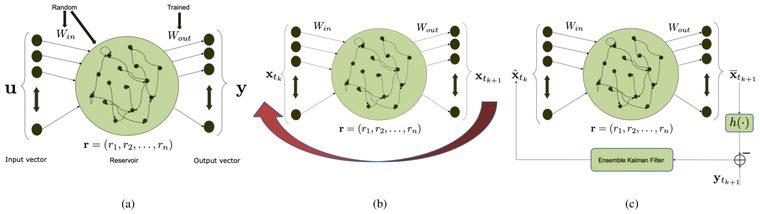
D. Goswami, A. Wolek, D. A. Paley, Data-driven estimation using an Echo-State Neural Network equipped with an Ensemble Kalman Filter. In Proc. 2021 American Control Conference, New Orleans, LA, 2021. [preprint]
Estimates the state of a complex nonlinear system from sparse measurements without a model, by training an echo-state network on representative data and assimilating the measurements with an ensemble Kalman filter.
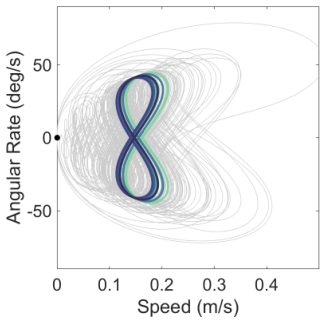
P. Ghanem, A. Wolek, D. A. Paley, Planar formation control of a school of robotic fish. In Proc. 2020 American Control Conference, Denver, CO, 2020. [preprint]
Nonlinear control for parallel and circular collective motion in a school of robotic fish modelled as Chaplygin sleighs driven by internal rotors, coupled through a connected, undirected communication graph.
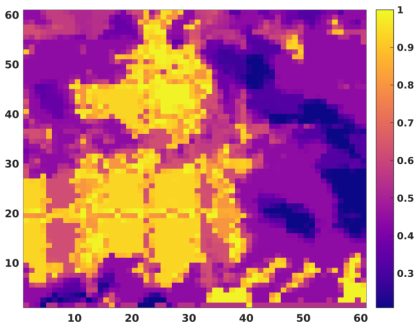
H. Yetkin, J. McMahon, N. Topin, A. Wolek, Z. Waters, and D. Stilwell, Online planning for autonomous underwater vehicles performing information gathering tasks in large sub-sea environments. In Proc. IEEE/RSJ Int. Conf. Intelligent Robots Sys., Macau, China, 2019.
An anytime Monte Carlo tree search producing near-optimal information-gathering paths for AUVs in large subsea areas, with an action-selection heuristic tailored to the case where turning costs more than continuing straight.
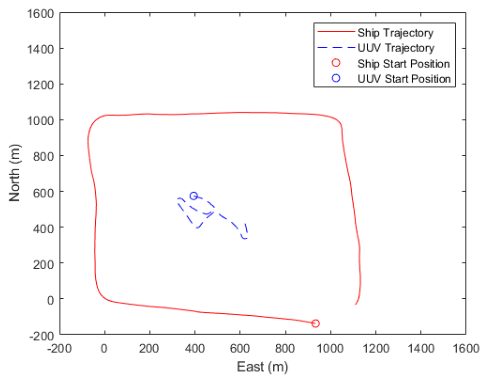
J. G. Jimenez, A. Wolek, D. Stilwell, J. McMahon, and B. Dzikowicz, Experimental results in bearings-only tracking with the sequential Monte-Carlo probability hypothesis density filter. In Proc. SPIE Defense + Commercial Sensing, Baltimore, MD, 2019.
Evaluates a sequential Monte Carlo probability hypothesis density filter for bearings-only tracking of surface ships, using data recorded by a Bluefin-21 underwater vehicle in Boston Harbor.
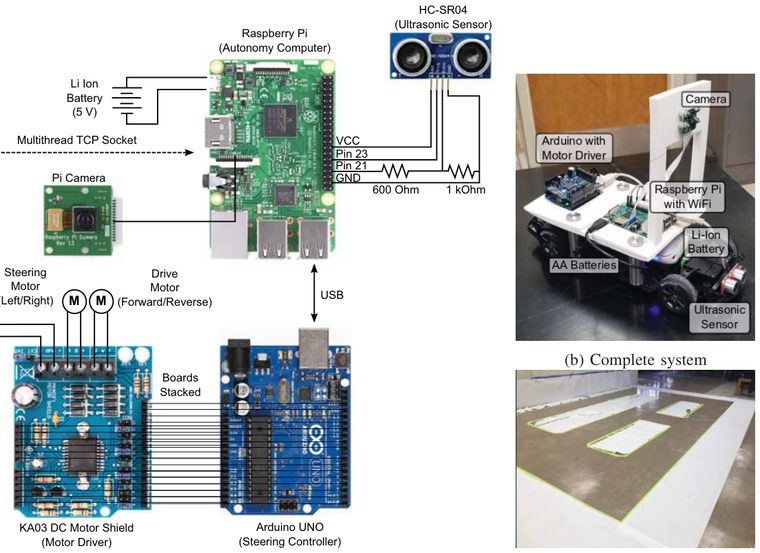
B. Simmons, P. Adwani, H. Pham, Y. Alhuthifi, and A. Wolek, Training a remote-control car to autonomously lane-follow using end-to-end neural networks. In Proc. IEEE Conf. Info. Sci. Sys., Baltimore, MD, 2019.
An end-to-end learning demonstration in which a low-cost remote-control car maps raw forward-camera images directly to steering and speed commands, comparing a deep network against a convolutional one, along with the vehicle's mechanical, electrical and software design.
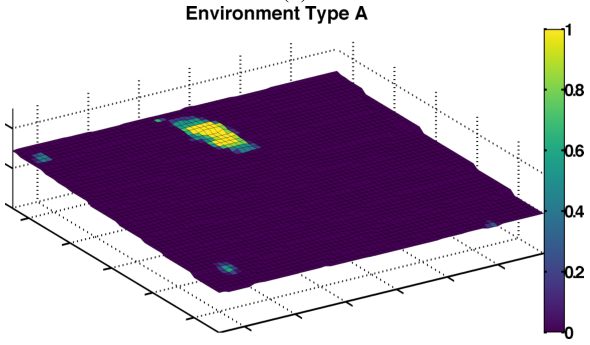
J. McMahon, H. Yetkin, A. Wolek, Z. Waters, and D. J. Stilwell, Towards real-time search planning in subsea environments. In Proc. IEEE/RSJ Int. Conf. Intelligent Robots Sys., Vancouver, Canada, 2017. [preprint]
Computes seafloor search paths in real time that maximize a formal measure of search effectiveness under finite search effort, accounting for false positives and for sonar performance that varies with the seabed.
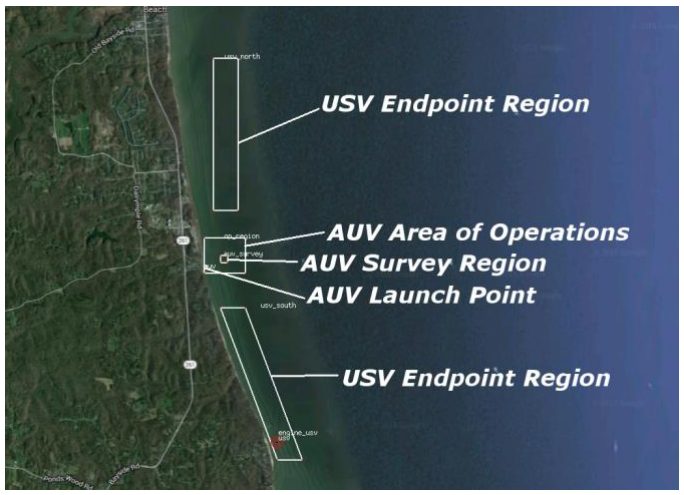
M. A. Wilson, J. McMahon, A. Wolek, D. Aha, and B. Houston, Toward goal reasoning for AUVs: responding to unexpected agents. In Proc. Workshop on Goal Reasoning at the 25th Int. Joint Conf. Artificial Intelligence, New York, NY, 2016.
Preliminary work applying a goal reasoning agent to an underwater vehicle in a partially observable, dynamic environment: an AUV pursuing a survey goal unexpectedly detects a potentially hostile surface vessel. Simulations run ahead of at-sea tests suggest goal-driven autonomy can reason about the situation within the computation available on an underwater platform.
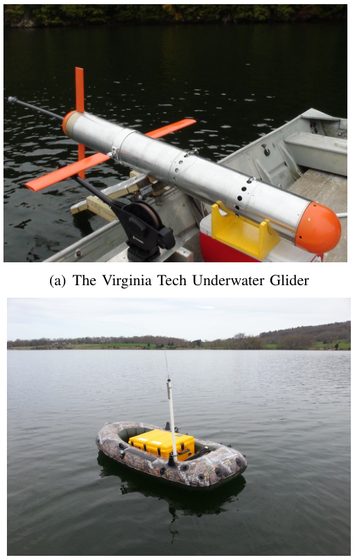
A. Wolek, T. Gode, C. A. Woolsey, J. Quenzer, K. A. and Morgansen, Testing a pneumatic underwater glider in shallow water. In Proc. MTS/IEEE OCEANS’15, Washington, DC, 2015. [preprint]
Shallow-water trials of a glider with a pneumatic buoyancy engine intended for fast, maneuverable littoral operation. The engine worked reliably, but bladder compressibility and the weight lost by venting air each dive dominated the trimming problem.
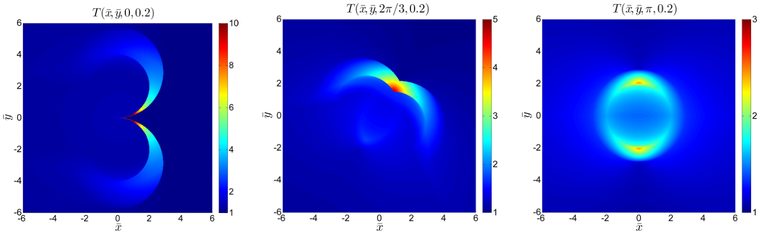
A. Wolek, and C. A. Woolsey, Disturbance rejection in Dubins path planning. In Proc. American Control Conf., Montreal, Canada, 2012.
A Dubins path that uses the maximum turn rate leaves no margin for the feedback corrections needed to reject disturbances, so in practice the planning turn rate is derated. This paper examines that trade-off.
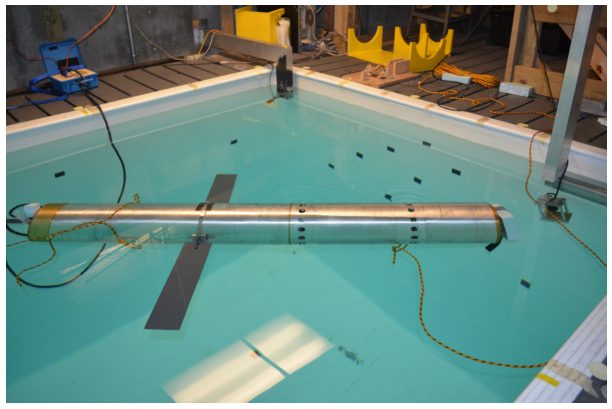
A. Wolek, J. Burns, C. A. Woolsey, J. Quenzer, L. Techy, and K. A. Morgansen., A maneuverable, pneumatic underwater glider. In Proc. MTS/IEEE OCEANS’12 Conf. and Expo., Hampton Roads, VA, 2012.
A 100 m coastal underwater glider with a pneumatic buoyancy engine and fast moving-mass actuators giving unrestricted roll, which makes asymmetric geometries such as wing camber usable. Built as a testbed for perception, planning and control algorithms.
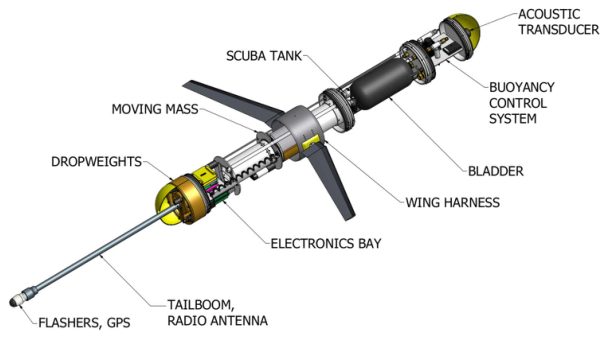
S. Fan, A. Wolek, and C. A. Woolsey, Stability and performance of underwater gliders. In Proc. MTS/IEEE OCEANS’12 Conf. and Expo., Hampton Roads, VA, 2012.
Relates a conventional underwater glider's geometry — fineness ratio among other parameters — to its stability and performance at two flight conditions: minimum drag and maximum horizontal speed.
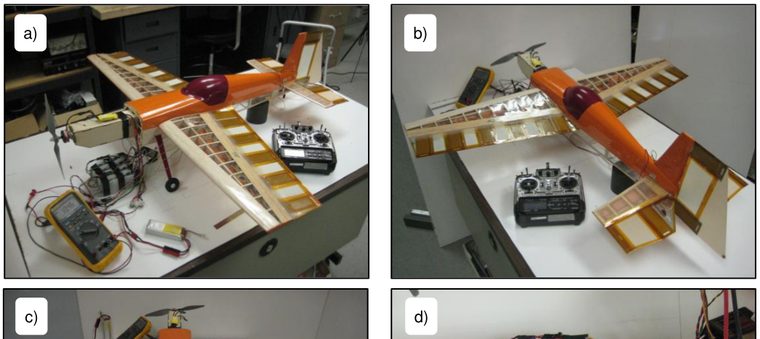
O. Bilgen, L. Butt, S. Day, C. Sossi, J. Weaver, A. Wolek, W. Mason, and D. Inman, A novel unmanned aircraft with solid-state control surfaces. In Proc. 52nd AIAA Structural Dynamics and Materials Conf., Denver, CO, 2011.
Final results from the 2010 Virginia Tech Wing Morphing Design Team: analysis and flight demonstration of an aircraft controlled entirely by piezoelectric Macro-Fiber Composite surfaces rather than servos.
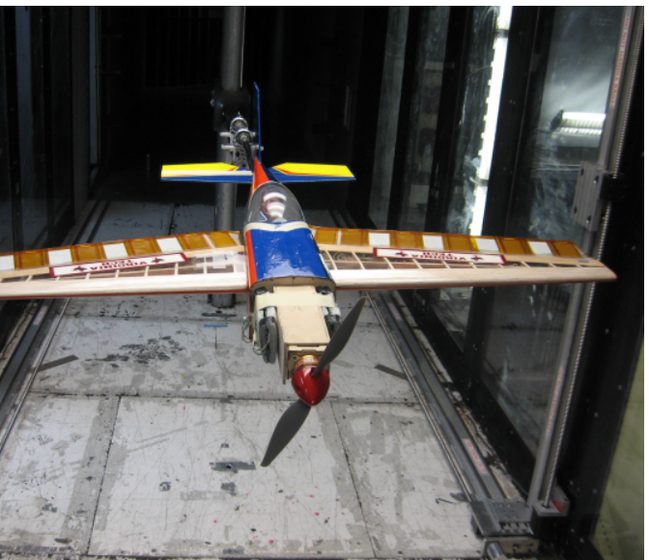
O. Bilgen, L. Butt, S. Day, C. Sossi, J. Weaver, A. Wolek, W. Mason, and D. Inman, Wing morphing design utilizing macro-fiber composite smart materials. In Proc. 69th Annual Conf. of The Society of Allied Weight Engineers, Virginia Beach, VA, 2010.
Presents the Virginia Tech Wing Morphing Design Team's aircraft, which replaces conventional servo-driven control surfaces with Macro-Fiber Composite smart-material actuators, to the Society of Allied Weight Engineers.
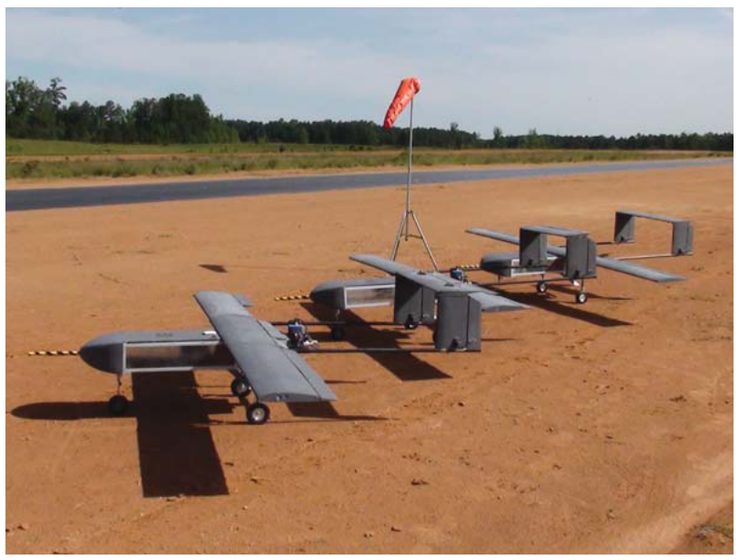
M. C. Cotting, A. Wolek, J. F. Murtha, C. and A. Woolsey, Developmental flight testing of the SPAARO UAV. In Proc. 48th AIAA Aerospace Sciences Meeting and Expo., Orlando, FL, 2010. [preprint]
Developmental flight testing of SPAARO, a UAV fleet designed and built at Virginia Tech to augment the undergraduate aircraft flight mechanics curriculum, and the issues encountered bringing it into service.
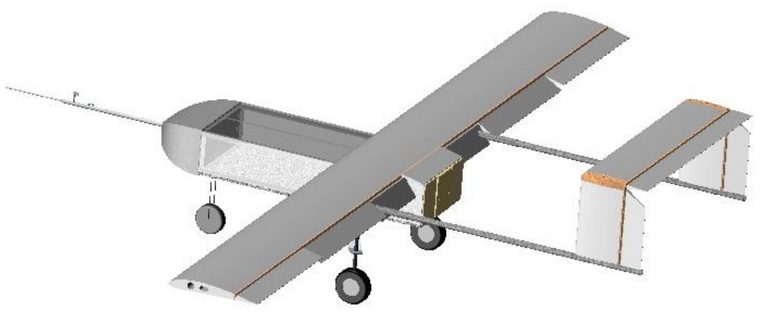
J. F. Murtha, M. C. Cotting, A. Wolek, T. Aarons, and C. A. Woolsey, The educational impact of creating a new UAV for curriculum enhancement. In Proc. AIAA Atmospheric Flight Mech. Conf., Chicago, IL, 2009.
Describes designing and building a new UAV fleet to augment Virginia Tech's undergraduate aircraft flight mechanics curriculum, and the educational effect of involving students in creating it.
Undergraduate Research
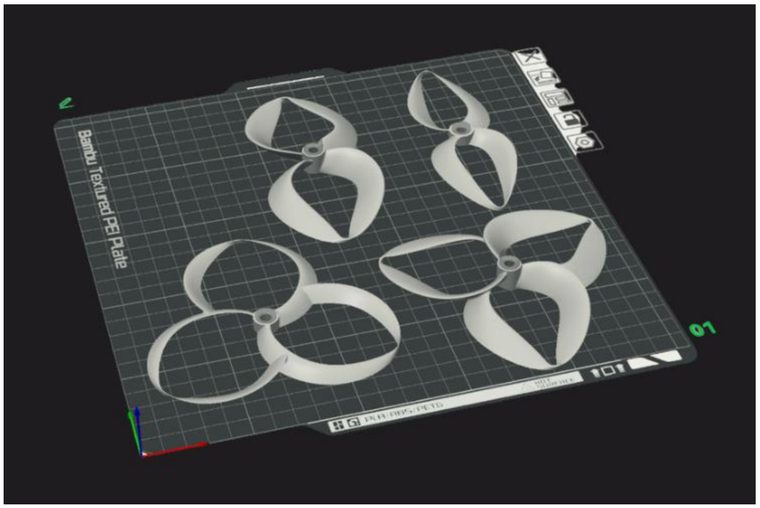
A. Das, Aero-acoustic optimization and experimental validation of a NACA 2415 toroidal UAV propeller. In Proc. AIAA 2026 Region II Student Conference, Columbia, SC, 2026.
Optimizes a NACA 2415 toroidal propeller for small multirotors, where standard injection-molded propellers favour manufacturability over acoustic performance, and validates the aero-acoustic predictions experimentally.
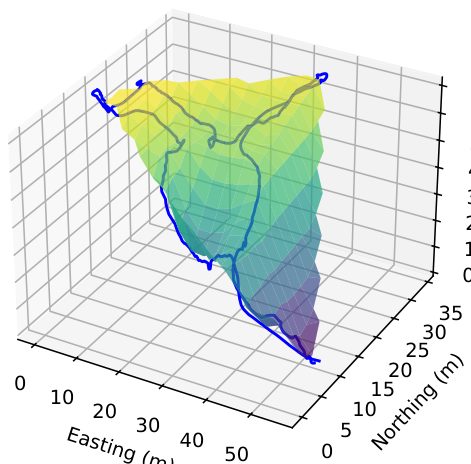
M. Nguyen, Off-road terrain mapping for autonomous ground vehicle energy-optimal path planning , In Proc. AIAA 2025 Region II Student Conference, Greensboro, NC, 2025.
Builds a local terrain elevation map from onboard sensing on a Clearpath Jackal, so an autonomous ground vehicle can plan energy-efficient routes across unstructured off-road ground.
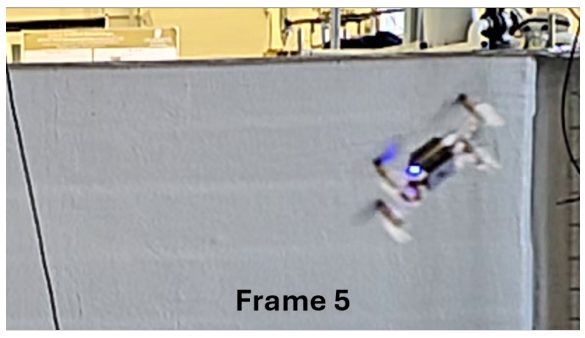
K. VanHorn, Experimental characterization of a quadrotor’s response to an air vortex cannon , In Proc. AIAA 2025 Region II Student Conference, Greensboro, NC, 2025.
Characterizes experimentally how a quadrotor responds to a vortex ring fired from an air cannon — a repeatable laboratory stand-in for the shock and gust disturbances UAVs encounter in hostile environments.
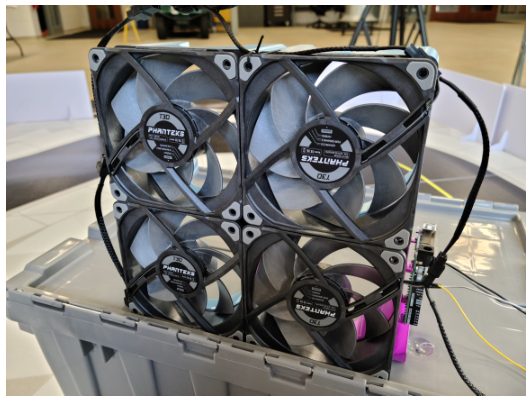
K. VanHorn, Machine-learning-based wind detection and avoidance using a crazyflie micro drone. In Proc. AIAA 2024 Region II Student Conference, Kennedy Space Center, FL, 2024.
Investigates whether onboard sensor data from a Crazyflie micro drone can be used to detect and map urban wind conditions with machine learning, feeding that information back into path planning and control.
Technical Reports
-
C. Hague and A. Wolek, Occlusion-aware ground target search by a UAV in an urban environment. arXiv e-print, 2025. [arXiv e-print]
-
A. Wolek, Evaluation of USV technology for bathymetric surveying of inland environments. Project FHWA/NC/2024-20 Final Report, North Carolina Department of Transportation, 2025. [report]
-
J. W. McMahon, B. Dzikowicz, P. Amy, B. Houston, and A. Wolek, NRL Boston 2018 autonomy experiment results and analysis. U.S. Naval Research Laboratory, Internal Report, 2019.
-
A. Wolek, T. Gode, C. A. Woolsey, J. Quenzer, and K. A. Morgansen, Design and testing of a pneumatically propelled underwater glider. Virginia Center for Autonomous Systems, Report No. VaCAS-2015-01, 2015. [report]